|
Summary Operational strategies to design and optimize the local business conversion funnel: ToFu, MoFu, BoFu with tactics for Meta, TikTok, Google, and YouTube, useful metrics (CPC, CTR, CPA, ROAS) and a practical method for analyzing competitors. Key takeaways
|
Introduction
The conversion funnel for local businesses is the map that guides a user from first contact to purchase or booking. Its practical application is essential when planning advertising campaigns on Meta, TikTok, Google, or YouTube for restaurants, retail, gyms, or professional studios. In this guide you will find actionable tactics for each stage of the funnel (ToFu, MoFu, BoFu), the KPIs to monitor, and a method to analyze competitors.
What is the conversion funnel for local businesses
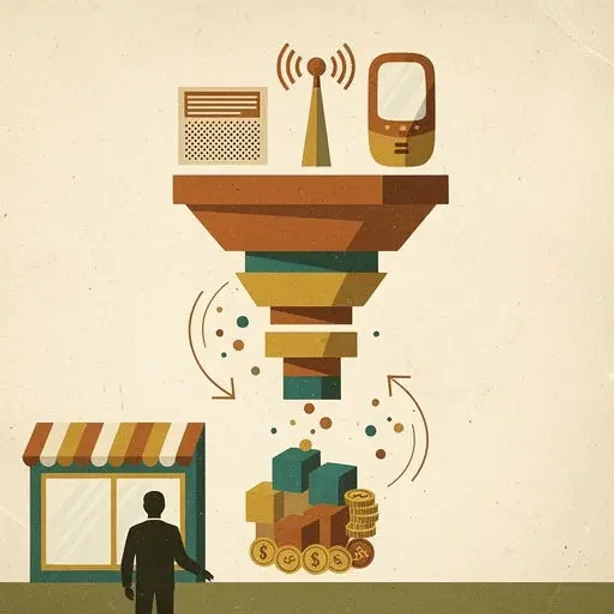
A conversion funnel is the path a prospective customer takes from awareness to purchase, narrowing as people drop off along the way. For local businesses this means turning visits into calls, bookings, or in-store visits and reducing friction at every step.
ToFu, MoFu, BoFu: the three macro-phases
Top of Funnel (ToFu) is the discovery phase: the goal is to attract qualified traffic and increase brand awareness. Here users search for general information and answers to their needs; they are not yet ready to buy.
ToFu: tactics and content
Use educational content and broad formats: optimized blogs, short videos, infographics, and influencer collaborations to reach new audiences. For local businesses, practical examples include video tours of the venue, clips of customer experiences, or seasonal content on Instagram and TikTok.
ToFu live test: promote a 15–30 second video on Meta and TikTok with a soft CTA (learn more) and measure reach, views, and CTR to identify the relevant audience.
ToFu Metrics
Tracking new users, average time on page, and social engagement rate helps assess whether the creative and targeting are working. These indicators show how well your message resonates and whether it drives users toward MoFu.
MoFu: turning interest into consideration
Middle of Funnel is the evaluation stage: here you must nurture leads with content that reduce objections and demonstrate tangible value. For local businesses, this means showing reviews, service comparisons, demos, or targeted local offers.
MoFu: tactics and content
Implement email nurturing, targeted retargeting, local demos or trials, and comparison content to help the prospective customer decide. For example, a restaurant can promote seasonal menus and reviews while a fitness center offers a free class.
MoFu Metrics
Measure conversion rates on gated content, requests for demos, revisit rates, and interactions with nurturing emails. These metrics indicate the quality of the lead and the likelihood of moving to BoFu.
MoFu practical: segment the audience who visited the pricing page and show a sequence of ads with testimonials and case studies to build trust.
BoFu: guiding the final decision
Bottom of Funnel is the point where the lead is ready to decide: you need content that eliminates the last doubts and facilitates action. For local businesses, key conversions are bookings, calls, in-store purchases, or form submissions.
BoFu: tactics and content
Use testimonials, comprehensive FAQs, limited-time offers, and direct outreach to push for conversion; integrate live chat and clear calls to action on landing pages and ads. A practical example is an automated email with a booking link sent immediately after a user visits the services page.
BoFu Metrics
Here you measure conversion rate, CPA, ROAS, and customer acquisition cost to understand the economic sustainability of your campaigns. Also analyze retention rate to assess the long-term value of the acquired customer.
Key performance KPIs
To evaluate ads campaigns on Meta, TikTok, and Google, monitor CPC, CPM, CTR, CPA, and ROAS alongside on-site conversion metrics. These numbers reveal where to intervene: creativity, offer, or targeting.
How to analyze competitors and learn from their funnel structure
Identify top competitors and study their high-performing pages to reveal tactics and gaps you can exploit. Focus on which pages receive traffic, what kinds of calls-to-action they use, and which content is most common in MoFu and BoFu stages.
Practical steps for analysis
-
Identify domains with high conversion rates and note the content categories they use.
-
Check audience overlap to understand if their audience is similar to yours.
-
Analyze main channels (direct, organic, paid) to allocate budget where it makes sense.
-
Examine top pages to understand elements that convert: CTAs, urgency, social proof, and trust signals.
Rapid testing and iteration
Set up A/B tests on visuals, landing pages, and follow-up sequences to quickly find the most effective combinations. Change one variable at a time (headline, image, CTA) and measure the impact on CTR and CPA.
Multichannel integration: coordinating Meta, TikTok, Google, and YouTube
A successful multichannel strategy leverages each platform’s strengths: awareness videos on TikTok and YouTube, retargeting on Meta, and search on Google for intent-driven signals. Coordinating messages and creativity reduces fragmentation and optimizes the user journey.
Practical example of a multichannel plan
Phase 1: launch a ToFu video on TikTok/YouTube to generate interest; Phase 2: retarget on Meta with MoFu content; Phase 3: targeted Google Search ads for high-intent queries and BoFu landing pages. This flow lowers CPA compared to using a single channel in isolation.
Critical paragraph: pros and cons of the local business funnel model
The funnel provides a useful framework but is not a universal solution: it must be adapted to local behavior and market seasonality. Some advantages include the ability to measure and optimize each stage (reducing advertising waste) and the clarity in defining distinct content and objectives for ToFu, MoFu, and BoFu. However, there are practical limits: for local businesses, variability in in-store visits, word-of-mouth, and offline events can generate signals difficult to track digitally. Additionally, advertising clutter on platforms like Meta and Google can drive up CPC and CPM, forcing ongoing tests of creativity and targeting. Another point of debate concerns spend: allocating budget between awareness and conversion requires historical data that many SMEs lack; this often leads to conservative choices or over-investment in channels that do not generate qualified leads. On the other hand, an agile, fast-testing approach allows small local businesses to discover low-cost demand niches. Finally, privacy and tracking limitations (such as pixel attenuation) require integrating first-party signals and strengthening the direct relationship with customers (email, phone, SMS) to compensate for reduced visibility. In conclusion, the funnel remains a powerful tool if adapted: it pays to combine digital metrics with offline indicators and maintain a continuous testing roadmap to reduce risk and improve ROI.
Operational checklist to get started
-
1) Define clear objectives for each stage (awareness, lead, sale) and the corresponding KPIs.
-
2) Map content and channels for ToFu, MoFu, BoFu with tailored creatives.
-
3) Implement tracking and segmentation to measure CPC, CTR, CPA, ROAS.
-
4) Run ongoing A/B tests on ads and landing pages and log results.
-
5) Monitor competitors and adapt strategies where opportunities are found.
Conclusion: putting the funnel into practice to grow a local business
A well-designed funnel improves conversions and optimizes advertising spend, but it requires testing, data, and integration between digital channels and offline touchpoints. Start with essential metrics, build targeted content for ToFu, MoFu, and BoFu, and use tests to iterate quickly: a series of small improvements reduces CPA and increases the value of each acquired customer.
Practical tip: start by testing a single local offer (e.g., booking discount) and measure CPA and conversion rate before scaling to more channels.